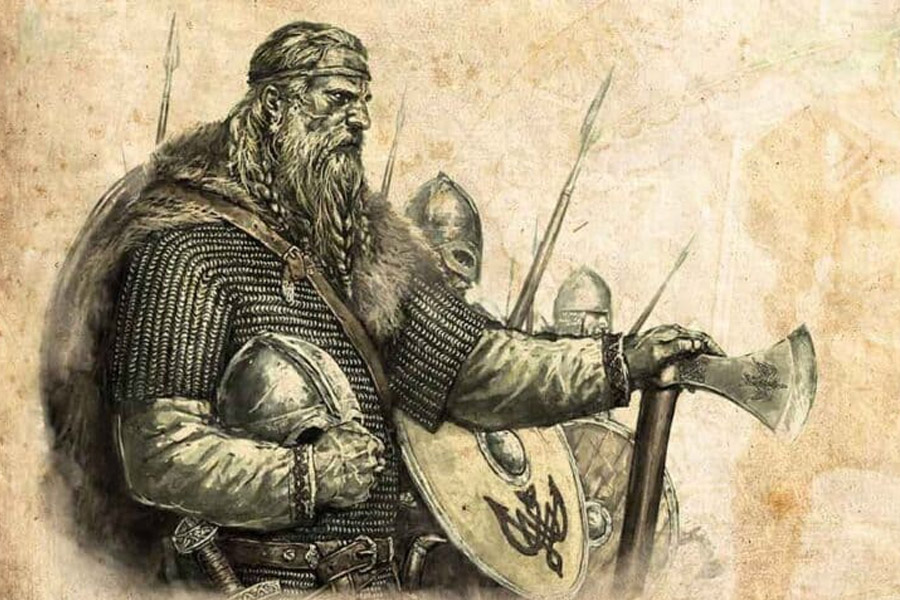
Basic information
| Field | Details |
|---|---|
| Name used here | Harold Bluetooth |
| Full name | Harald Gormsson |
| Also known as | Harald Bluetooth, Harald Blåtand |
| Born | c. 910 |
| Died | c. 985 to 987 |
| Realm | Denmark, with influence in Norway |
| Father | Gorm the Old |
| Mother | Thyra Danebod |
| Most famous for | Uniting Denmark, promoting Christianity, building royal fortifications |
| Famous monument | The Jelling stones |
| Later cultural legacy | The Bluetooth name and logo |
A king with a name that outlived his throne
Harold Bluetooth was one of those monarchs whose legacy outlasted his time. His Viking kingship was not limited to raids and smoke. Construction, consolidation, and political art were his skills. His power went beyond the blade. Roads, bridges, stones, alliances, and symbols endured.
He ruled Denmark in the 10th century, while royalty was still being forged. From his Jelling-born royal dynasty, he united a patchwork nation. The Harold Bluetooth story involves many people. A family, dynasty, and kingdom learn to talk together.
The royal family that shaped him
Harold Bluetooth was the son of Gorm the Old and Thyra Danebod. That alone puts him at the center of one of the most important royal households in early Danish history. Gorm gave the dynasty its hard backbone. Thyra carried a memory that later generations treated almost like legend. Together, they formed the soil from which Harold grew.
Gorm the Old stands as the father figure in the Jelling line. He represents the older, more rugged phase of royal power, when loyalty was personal and rule depended on the force of a king’s presence. Harold inherited that world, but he did not simply repeat it. He widened it.
Thyra Danebod is often remembered with a kind of luminous respect. In later tradition, she appears as a wise and important queen, a figure tied to Danish identity itself. Her name lives on in the Jelling inscriptions, which makes her more than a footnote. She is part of the family’s public face, the kind of ancestor a dynasty keeps polished like a shield.
Wives, queens, and the uncertain edges of the record
Harold Bluetooth’s personal life is less certain than his monuments, but the sources and traditions point to several important women around him. One name often linked to him is Tove, a princess of Slavic origin. Her connection to Harold comes from a rune stone, which makes her especially interesting because she is not merely a later storyteller’s invention. She stands in the stone-light of history, close to the king but still partly veiled.
Another name tied to Harold is Gunhild. Some traditions call her his wife and connect her to Sweyn Forkbeard, Harold’s most famous son. Yet the story is not entirely settled, and that uncertainty matters. Royal families of the Viking Age often appear in fragments, like broken mosaic glass. You can see the colors, but not always the full pattern.
A third name, Gyrid, is also mentioned in later accounts. Whether she was a wife, a queen, or a figure blurred by storytelling, she belongs to the wide circle of Harold’s personal history. When I look at these traditions together, I see a king whose domestic life was probably as political as his public reign. Marriages were bridges. They connected kingdoms, factions, and bloodlines.
Children and descendants
Harold Bluetooth’s children matter because they carried his legacy into the next generation, sometimes faithfully, sometimes in rebellion. Sweyn Forkbeard is the most important among them. He became king after turning against his father, which is almost a Viking drama in itself. Bloodline in that age was not a soft ribbon. It was a blade passed from hand to hand.
Sweyn’s rise changed everything. Through him, Harold became the grandfather of rulers who would shape the North Sea world, including Canute the Great. The line did not stop at Harold. It expanded like a tree with strong roots and heavy branches.
Other children are remembered in tradition as well. Thyra, also called Tyra in some forms, appears in marriage alliances that linked Denmark to other Scandinavian powers. Gunhild is another child associated with broader dynastic ties, her life woven into the web of noble marriages and political alliances. There are also traditions naming Hiring and Håkon, though these figures belong to the more shadowed edge of the family story.
The grandchildren continue the royal chain. Harald II appears among the descendants through Sweyn Forkbeard, and Estrid Svendsdatter is often placed in the broader family memory as well. These names show how Harold Bluetooth’s bloodline kept moving after his death, like a river that never stopped finding lower ground.
A ruler who turned power into infrastructure
Harold Bluetooth was not only a family man and dynastic figure. He was a workman of power. He helped consolidate Denmark under a single ruler and pushed Christianity into the royal and public sphere. He did not just announce change. He built it into the landscape.
The Jelling stones are the heart of this achievement. They are not ordinary memorials. They are proclamation in stone, a royal voice cut into the world. One stone honors Gorm and Thyra. Another announces Harold’s role in uniting Denmark and bringing Christianity to the Danes. In a time before printing presses, that was a megaphone made of granite.
He also supported major fortifications, including the ring forts, and oversaw the construction of the Ravning Enge bridge. That bridge, enormous for its time, shows a mind that understood movement and control. A kingdom is not only defended by walls. It is connected by crossings. Harold seems to have understood that very well.
Harold Bluetooth in memory and modern culture
Harold Bluetooth’s name traveled far after his world disappeared, which is strange. His name is known thanks to Bluetooth. Modern relationship is intentional. It represents unification, as Harold once unified land and authority. Wireless connection used a longship king as its mascot. History’s irony is keen like a new axe.
His modern afterlife has kept him alive in popular imagination. Many recognize the name before the man. Still, the name recalls a historical king whose life was full of consequence. He was no myth floating in the mist. This monarch left stone, fortification, lineage, and remembrance.
Timeline of key moments
Harold Bluetooth was born around 910. By about 958, he had become king of Denmark. In the 960s, he emerged as a public Christian ruler and marked his authority in the Jelling monuments. Around 980, the ring forts and the Ravning Enge bridge took shape under his reign. Near the end of the century, his son Sweyn Forkbeard rebelled. Harold died around 985 to 987, and the exact place of his burial remains uncertain.
That sequence tells a compact story, but the pace was anything but small. Each decade brought another layer of power, another stone, another sign that Denmark was changing.
FAQ
Who was Harold Bluetooth?
Harold Bluetooth was a 10th century king of Denmark, remembered for uniting the kingdom, supporting Christianity, and leaving behind major royal monuments and fortifications.
Who were Harold Bluetooth’s parents?
His parents were Gorm the Old and Thyra Danebod. They belong to the royal line centered at Jelling and are central to his family identity.
Who were Harold Bluetooth’s children?
The best known child is Sweyn Forkbeard. Other children or descendants in tradition include Thyra, Gunhild, Hiring, and Håkon, though some of these family links are less certain than others.
Why is Harold Bluetooth famous today?
He is famous both for his role in Danish history and because modern Bluetooth technology took its name from him. His legacy turned into a symbol of connection.
What was Harold Bluetooth’s greatest achievement?
I would call it his creation of a stronger Danish kingdom. He unified power, strengthened royal authority, and marked his reign with the Jelling stones, which still stand like a royal signature carved into time.
Did Harold Bluetooth have a complicated family?
Yes. His family story is a knot of power, marriage, succession, and rebellion. That complexity is part of what makes him so interesting. His household was not a quiet chamber. It was a dynastic forge.